Loose-Leaf Tea: a guide to choosing, dosing and storing it properly
Loose-Leaf Tea: a guide to choosing, dosing and storing it properly
Loose-leaf tea has something deeply sensory about it. Even before infusion, it can be looked at, smelled and measured. The leaves reveal their colour, cut, texture and botanical, fruity, floral, spiced or indulgent notes. Unlike a sachet, loose-leaf tea invites a freer, more personal gesture, almost a ritual.
But one question often comes up: how should you dose loose-leaf tea? Too little, and the cup lacks intensity. Too much, and it can become bitter or too powerful. Other questions follow: what quantity for one cup? Which temperature should you choose? How long should it be infused? How should loose-leaf tea be stored to preserve its qualities?
This guide takes you step by step through choosing, dosing, preparing and storing your loose-leaf tea, so you can fully enjoy every Provence d’Antan cup.
Why choose loose-leaf tea?
How to dose loose-leaf tea
Which dosage according to the type of tea?
How to prepare loose-leaf tea without damaging it
Which temperature and infusion time should you choose?
Which accessories should you use for loose-leaf tea?
How to store loose-leaf tea
Loose-leaf tea or tea bag: what are the differences?
Which Provence d’Antan products should you discover?
Precautions to know
Key points
FAQ
Why choose loose-leaf tea?
Loose-leaf tea allows you to observe the leaves and adjust your tasting more precisely. You choose the quantity, the infusion time, the intensity of the cup and even the type of accessory used. It is a freer way to prepare tea.
It is also greatly appreciated by lovers of rituals. Opening the tin, dosing the leaves, heating the water to the right temperature, watching the infusion take on colour: each step contributes to the pleasure of tasting.
Loose-leaf tea also allows the preparation to be adapted to the moment of the day. A light cup in the morning, a more generous teapot at afternoon snack time, a shorter infusion to avoid bitterness, an iced preparation in summer: everything can be adjusted.
At Provence d’Antan, loose-leaf teas and infusions belong to this idea of simple pleasure, generosity and careful tasting.
How to dose loose-leaf tea
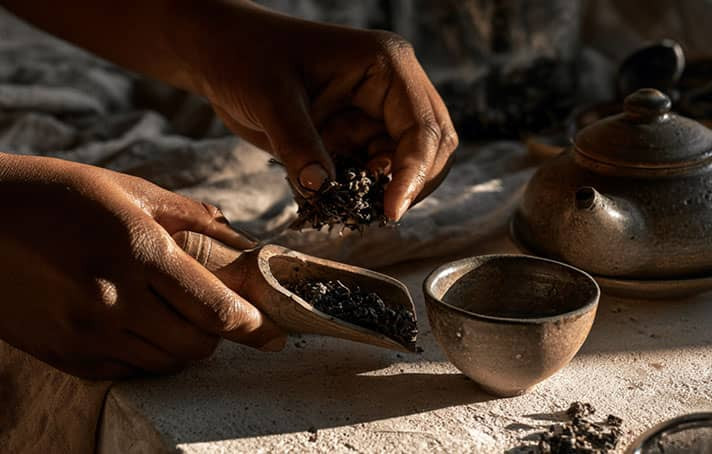
The simplest rule is to count around 2 g of loose-leaf tea for 200 ml of water, the equivalent of a classic cup. This often corresponds to one level teaspoon, but this reference can vary according to the cut of the tea.
Tea with long, voluminous leaves will take up more space in the spoon than a more finely cut tea. That is why measuring with a spoon remains practical, but approximate. For more precision, a small scale can be useful, especially if you often prepare tea in a teapot.
Simple dosage guidelines
For a 200 ml cup: around 2 g of loose-leaf tea.
For a 300 ml mug: around 3 g of loose-leaf tea.
For a 500 ml teapot: around 5 g of loose-leaf tea.
For a 1-litre teapot: around 10 g of loose-leaf tea.
The aim is not to overload the cup. Tea that is dosed too heavily can become bitter, especially if it is infused for too long or with water that is too hot.
Which dosage according to the type of tea?
Loose-leaf green tea
Green tea is delicate. It is generally dosed at around 2 g for 200 ml of water. It does not tolerate boiling water or overly long infusions well, as these can bring out bitterness.
For green tea, it is best to use water at around 75 to 85°C and a short infusion, often 2 to 3 minutes, depending on the product.

Loose-leaf black tea
Black tea is more robust. It can be dosed at around 2 g for 200 ml, with hotter water, generally around 90 to 95°C. The infusion time is often between 3 and 5 minutes.
It is very well suited to breakfast, afternoon snack time or more structured pauses during the day.

Loose-leaf white tea
White tea is more subtle. Its leaves are often more voluminous, which can make spoon dosing less precise. Count around 2 g for 200 ml, with gentler water, around 70 to 80°C, and a longer infusion, often 4 to 5 minutes.

Loose-leaf rooibos
Rooibos contains no theine. It can be dosed a little more generously depending on the desired intensity, around 2 to 3 g for 200 ml. It tolerates very hot water and a longer infusion well, often 5 to 7 minutes.

Loose-leaf infusion
For a plant or fruit infusion, the dosage depends greatly on the cut and composition. On average, count one tablespoon or one heaped teaspoon per cup, depending on the density of the blend. Infusions often require very hot water and a longer infusion time, around 6 to 8 minutes.

How to prepare loose-leaf tea without damaging it
Preparing loose-leaf tea relies on three elements: quantity, temperature and time.
A good cup does not depend only on dosage. Even with the right quantity of leaves, green tea infused in water that is too hot can become bitter. Conversely, black tea that is not infused enough may lack relief.
The right gestures
Start by dosing the leaves according to the volume of water.
Place them in an infuser large enough for them to unfold.
Heat the water to the temperature suited to the type of tea.
Pour the water over the leaves.
Leave to infuse for the recommended time.
Remove the leaves to avoid an overly intense infusion.
The important point: the leaves need space. A tea ball that is too small can compress them and limit diffusion. A paper filter, infuser basket or teapot with a large filter often allows for better extraction.
Which temperature and infusion time should you choose?
Tea does not like approximation. Temperature and infusion time directly influence taste.
Practical guidelines
Green tea
75 to 85°C — 2 to 3 minutes.
Black tea
90 to 95°C — 3 to 5 minutes.
White tea
70 to 80°C — 4 to 5 minutes.
Rooibos
Around 95°C — 5 to 7 minutes.
Plant or fruit infusion
95 to 100°C — 6 to 8 minutes.
These guidelines should always be adapted to the advice indicated on the product. Some blends require a specific temperature or duration.
Which accessories should you use for loose-leaf tea?
The infuser basket
It is one of the most practical accessories. It gives the leaves enough space to unfold and can be easily removed after infusion.
The paper filter
It is ideal for a cup on the go or a simple preparation. It works well for finer blends.
The teapot with filter
It is perfect for preparing several cups. It allows the tea to be dosed according to the total volume and creates a true moment of sharing.
The tea ball
It can be useful in a pinch, but it is sometimes too small for long leaves. It is better to choose a ball large enough to let the leaves breathe.
The measuring spoon
It helps keep a regular reference. For more precision, especially with delicate teas, a small scale remains the most reliable option.
How to store loose-leaf tea
Loose-leaf tea is sensitive to air, light, humidity, heat and odours. To preserve its qualities, it should be stored in a tightly closed tin, away from light and temperature variations.
Avoid placing it near a hob, window, sink or very fragrant spices. Tea easily absorbs surrounding odours.
The right habits
Store tea in an airtight tin.
Keep it away from light.
Avoid humidity.
Do not store it near coffee or strong spices.
Close the tin after each use.
Use a dry spoon.
Well-stored tea keeps its taste balance for longer. It does not necessarily become dangerous after a few months, but it can lose intensity, freshness and finesse.
Loose-leaf tea or tea bag: what are the differences?
Loose-leaf tea offers more freedom. It allows you to dose according to your taste, prepare a cup or a teapot, see the leaves and adjust the intensity.
Tea bags are more practical, quicker and easier to carry. They offer a dosage already designed for one cup, which reassures people who do not want to measure.
Both formats therefore have their value. Loose-leaf tea suits lovers of rituals and personalisation. The sachet suits quick pauses, the office, travel or moments when you want simple preparation.
At Provence d’Antan, the ideal choice depends on the moment: loose-leaf for home and tasting moments, sachets for everyday simplicity.
Which Provence d’Antan products should you discover?
Provence d’Antan loose-leaf teas
To discover the pleasure of free leaves, Provence d’Antan loose-leaf teas make it possible to compose a more personal tasting moment. Green tea, black tea, white tea or more indulgent creations: loose-leaf tea invites you to adjust each cup according to the desire of the moment.
Discover our loose-leaf teas
https://provence-dantan.fr/fr/63-thes-en-vrac
Loose-leaf infusions
Loose-leaf infusions are ideal for those who enjoy preparing a large cup, a teapot or a carafe. Plants, fruits, flowers or spices unfold generously in hot water to offer a fuller tasting experience.
Explore our loose-leaf infusions
https://provence-dantan.fr/fr/64-infusions-en-vrac
Tea accessories
Infuser, filter, tea ball, spoon or teapot: accessories make preparing loose-leaf tea easier and help obtain a consistent cup. They are particularly useful for dosing properly, letting the leaves unfold and removing the infusion at the right time.
Find the accessory suited to your ritual
https://provence-dantan.fr/fr/68-accessoires
Provence d’Antan metal tins
To store loose-leaf tea in good conditions, a well-closed metal tin is a beautiful ally. It protects the leaves from light and limits their exposure to air, while bringing a decorative touch to the kitchen.
Discover our metal tins
https://provence-dantan.fr/fr/190-boites-metal
Precautions to know
Green tea, black tea, white tea and maté naturally contain theine. Sensitive people may prefer to consume them in the morning or early afternoon.
An infusion that is too heavily dosed or too long can become bitter, but also more concentrated in theine when it is tea. It is therefore preferable to respect the advice indicated on each product.
In case of pregnancy, breastfeeding, medical treatment, known medical condition, sensitivity to theine or doubt, seek advice from a healthcare professional before regular consumption.
For children, choose suitable theine-free infusions, always checking the composition.
Key points
To dose loose-leaf tea, count around 2 g for a 200 ml cup.
A level teaspoon can serve as a reference, but density varies according to the leaves.
Green tea requires cooler water and a shorter infusion than black tea.
Rooibos and plant infusions often tolerate a longer infusion.
Loose-leaf tea should be stored away from air, light, humidity, heat and odours.
An infuser basket or teapot with filter allows the leaves to unfold properly.
The right dosage also depends on your taste: lighter, more intense, shorter or rounder.
FAQ
How should you dose loose-leaf tea?
To dose loose-leaf tea, count on average 2 g of tea for 200 ml of water, or about one level teaspoon. For a 1-litre teapot, allow around 10 g of tea. The dosage may vary according to the type of tea and the desired intensity.
How much loose-leaf tea for one cup?
For a classic 200 ml cup, use around 2 g of loose-leaf tea. If you like a lighter cup, slightly reduce the quantity. If you want more intensity, increase the dosage a little without excessively extending the infusion.
How many spoons of loose-leaf tea for a teapot?
For a 500 ml teapot, count around 5 g of tea, or two to three teaspoons depending on the cut of the leaves. For a 1-litre teapot, count around 10 g.
How to prepare loose-leaf tea without an infuser
You can use a paper filter, a fine strainer or a classic teapot, then filter the tea when serving. The important thing is to remove the leaves after the recommended infusion time.
Why does my loose-leaf tea become bitter?
Tea often becomes bitter when it is too heavily dosed, infused for too long or prepared with water that is too hot. This is particularly true for green tea, which requires gentler water and a short infusion.
How to store loose-leaf tea
Store loose-leaf tea in an airtight tin, away from light, humidity, heat and odours. Avoid placing it near coffee, strong spices or a heat source.
Can loose-leaf tea be reused?
Some teas can be infused a second time, especially teas with whole leaves. The second infusion will generally be lighter. However, the leaves should be reinfused quickly and should not be left damp for too long.
What is the difference between loose-leaf tea and tea bags?
Loose-leaf tea allows you to dose it yourself, see the leaves and adjust the intensity. Tea bags are more practical and already dosed for one cup. The choice mainly depends on the moment, the desired ritual and the level of practicality you are looking for.
Which accessory should you choose for loose-leaf tea?
An infuser basket is often the most practical, as it lets the leaves unfold. A teapot with filter is ideal for several cups. Paper filters are suited to quick or on-the-go preparations.
How long should loose-leaf tea be infused?
The time depends on the type of tea. Count 2 to 3 minutes for green tea, 3 to 5 minutes for black tea, 4 to 5 minutes for white tea, 5 to 7 minutes for rooibos and 6 to 8 minutes for a plant or fruit infusion.